



Hashimoto's is the most common cause of an underactive thyroid, and it affects women far more often than men. It develops slowly, and a blood test can identify it years before thyroid levels change at all.

Reviewed by Allison Mollet, PA-C, MSCP
Updated August 2026
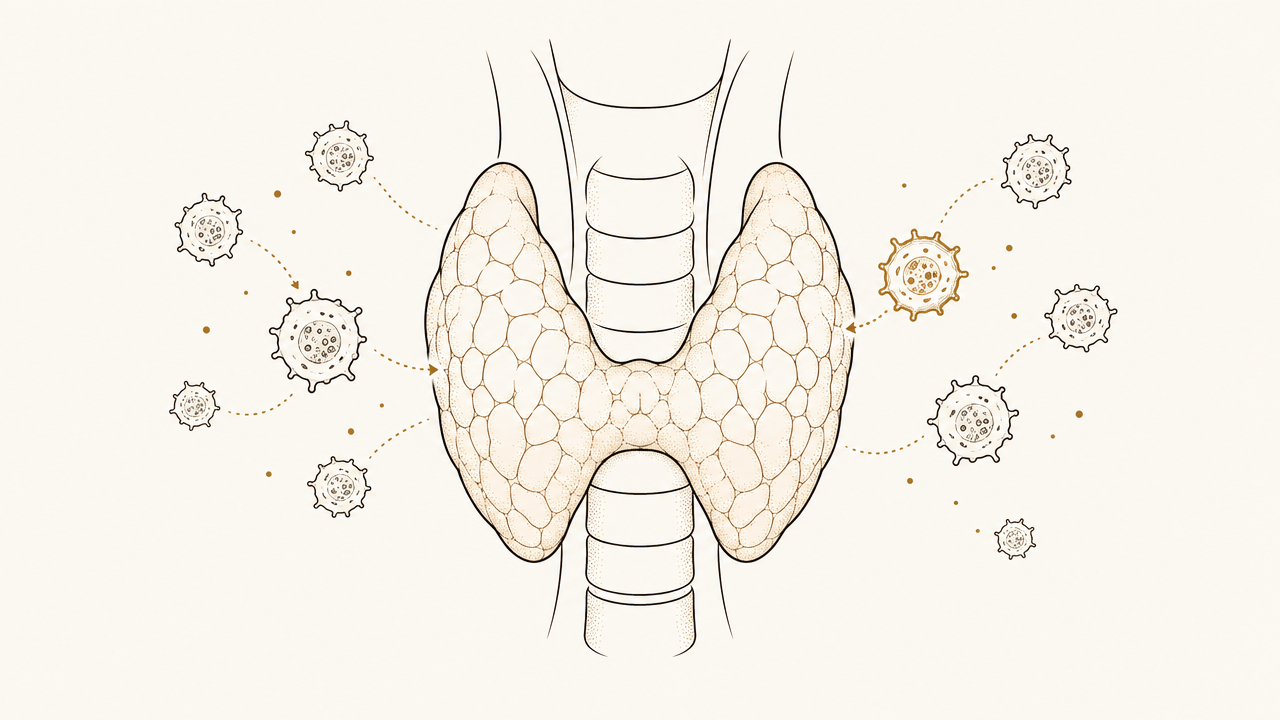
Hashimoto's is an autoimmune condition. The immune system produces antibodies against the thyroid and gradually damages the tissue that makes thyroid hormone.
The process is slow, typically developing over years. For much of that time the thyroid keeps up by working harder, prompted by a rising TSH from the pituitary.
This is why Hashimoto's is described in stages rather than as a single onset. Antibodies appear first. TSH rises next while T4 stays normal, which is subclinical hypothyroidism. Overt hypothyroidism, with a low T4, comes last if it comes at all.
Not everyone with antibodies progresses, and the pace varies considerably.
Autoimmune conditions in general are more common in women, and thyroid autoimmunity is one of the clearest examples.
The reasons are not fully established and involve sex hormones, immune differences, and genetics. What matters practically is the likelihood: for a woman with the relevant symptoms, autoimmune thyroid disease is a reasonable thing to check for.
It is more likely to appear, or to be noticed, at two points. After pregnancy, when thyroid dysfunction is relatively common in the year following delivery. And through the menopause transition, when thyroid disease becomes more frequent with age and its symptoms are easily attributed to the transition instead.
A personal or family history of other autoimmune conditions also raises the likelihood.
Hashimoto's itself does not usually produce symptoms. What produces symptoms is the hypothyroidism that can follow, and it develops slowly enough to be attributed to something else.
Fatigue that rest does not resolve. Weight gain without a change in eating. Feeling cold when others are comfortable. Dry skin, brittle hair or nails. Constipation. Low mood and difficulty concentrating. Heavier or irregular periods. A slowed heart rate.
Some women notice fullness or swelling at the front of the neck, though many do not.
Read as a list, these are the same symptoms produced by the perimenopausal transition and by iron deficiency, among others. That is why testing rather than assuming is the point.
TPO antibodies are directed against thyroid peroxidase, an enzyme the thyroid uses to make hormone. They are the main marker and are present in most people with Hashimoto's. Thyroglobulin antibodies are a second marker, used alongside them.
A positive result tells you the *cause*. It explains why a thyroid is underactive rather than only recording that it is. And because antibodies often appear before levels change, it can identify the process years earlier than function tests alone.
Two things a positive result does not mean. It does not mean you have hypothyroidism now, which depends on TSH and T4. And it does not predict when, or whether, you will.
Antibody levels are not tracked as a measure of the disease. They fluctuate, they do not correspond reliably to how you feel, and lowering them is not the goal of treatment. Thyroid function is what gets followed.
Knowing you have thyroid antibodies is worth something even when your levels are normal. It explains a borderline result, and it makes you someone whose thyroid gets followed rather than checked once. It does not create a reason to treat today. Where function is normal, we monitor and keep looking.
— Allison Mollet, PA-C, MSCP
This is a common result and a confusing one to receive.
Positive antibodies with a normal TSH and normal T4 means autoimmune activity is present and thyroid function is currently adequate. It is an early stage, not a diagnosis of hypothyroidism.
What follows is monitoring, at an interval based on your results and symptoms, so a change is identified when it happens rather than later.
What does not follow is thyroid medication. Treating normal thyroid function does not improve symptoms and can cause problems of its own.
If you have symptoms and normal levels, the antibodies do not explain them and the search should continue. In midlife the more likely explanations are the perimenopausal transition, iron deficiency, vitamin D or B12 deficiency, and disrupted sleep. All common, all treatable, all part of the comprehensive panel.
Where Hashimoto's has produced hypothyroidism, treatment is thyroid hormone replacement, adjusted with repeat testing until levels and symptoms settle. Levels take several weeks to stabilize after a change, so the process runs in months rather than weeks.
Treatment replaces what the thyroid can no longer make. It does not act on the autoimmunity, and no treatment reliably stops that process.
Timing affects absorption. Thyroid medication is taken on an empty stomach and separated from calcium, iron and certain other medications, which interfere with it.
Requirements change over time — with age, weight, other medications, pregnancy, and hormone therapy. This is a condition that is followed rather than resolved, which is a reasonable expectation to hold at the start.
Since treatment replaces thyroid hormone rather than acting on the immune process, the obvious question is whether anything else does. Here is where the evidence actually sits.
Correcting documented deficiencies is where the case is strongest. Vitamin D deficiency is common and worth correcting on general medical grounds. Selenium has been studied more than most supplements here, and iron, B12, zinc and magnesium all matter where labs show a deficiency.
The operative word is *documented*. We correct what your labs show is low. We do not recommend supplementing across the board on the assumption that something is.
A nutrient-dense, anti-inflammatory eating pattern supports general health, and so do sleep, movement and not smoking. Those help with the weight, energy and mood problems that travel with thyroid disease. They are not a treatment for the autoimmunity, and we would not present them as one.
Celiac disease is worth testing for, because it co-occurs with Hashimoto's more often than chance would predict. Where celiac is confirmed, a gluten-free diet is a clear indication.
For everyone else, the gluten evidence is thin. Studies of gluten-free eating in non-celiac Hashimoto's have not shown consistent effects on thyroid antibodies or function. Some women report feeling better; others notice nothing.
Autoimmune protocol and other restrictive diets have not been shown to change thyroid outcomes over the long term, and they are nutritionally demanding. If you want to try one, it is reasonable as a time-limited trial with guidance. It is not standard advice.
Anything here complements prescribed thyroid hormone. None of it replaces it.
We correct the deficiencies your labs show, and we support the eating and sleeping that help anyone feel better. Nothing available reliably switches off thyroid autoimmunity, and a restrictive diet undertaken in hope of it is a real cost for an uncertain return. Where a woman wants to try one, we would rather guide it.
— Allison Mollet, PA-C, MSCP
Let's begin
Your evaluation includes a full thyroid panel with antibodies, alongside your hormones, metabolic markers and nutrients, read together against how you feel. An unhurried hour with a Menopause Society Certified Practitioner, in Brea. To speak with us first, call 714-671-2005.
Thyroid testing: what a full panel shows
When it's thyroid and menopause at once
Perimenopause: what's happening, and what helps
Menopause: what changes, and what helps