



A thyroid test is usually a single number, and a single number answers a narrower question than most people assume. This page explains what each part of a panel measures, and how every value can come back normal while something real is going on.

Reviewed by Allison Mollet, PA-C, MSCP
Updated August 2026
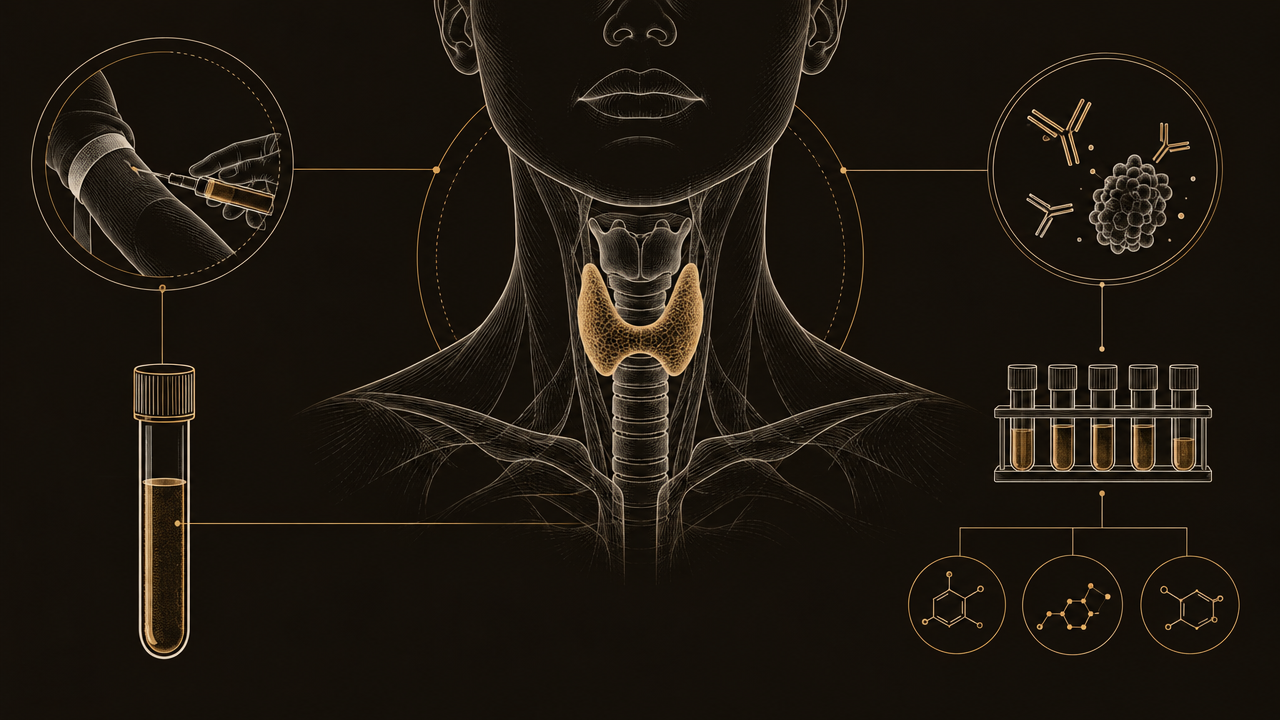
TSH, thyroid stimulating hormone. Produced by the pituitary, not the thyroid. It is the instruction the pituitary sends when it senses thyroid hormone is low.
A high TSH generally means an underactive thyroid, and a low TSH generally means an overactive one. The relationship is amplified, which makes TSH sensitive to small changes and is why it is the standard first test.
Free T4, thyroxine. The main hormone the thyroid produces, measured as the unbound portion available to your tissues. It shows what the thyroid is putting out rather than what the pituitary is asking for.
Free T3, triiodothyronine. The more active hormone. Most of it is converted from T4 in other tissues rather than produced by the thyroid directly.
Thyroid antibodies, TPO and thyroglobulin. These identify autoimmune thyroid disease, the most common cause of an underactive thyroid in women. They can be present before TSH or T4 has moved, which is why they are worth including. Our Hashimoto's page covers what that means.
A thyroid test usually means TSH. If it comes back inside the range, most women are told their thyroid is fine.
TSH is the pituitary's signal, and it rises as the thyroid's output falls. So where it sits inside the range matters. Low in the range generally means the thyroid is working comfortably. Higher up means the pituitary is having to push, and succeeding.
That is compensation. It is not failure, and for many women it is entirely fine.
But a thyroid being pushed harder to keep up is a different situation from one that is not, and a single number reported as normal does not distinguish between them.
The pattern that matters most is the one where nothing gets flagged. A TSH near the top of the range. A free T4 near the bottom. Antibodies present. Every value technically normal, and a real process underway.
No reference range finds that. Reading the panel together is what finds it.
TSH alone is a reasonable screening test and answers most questions correctly. We run more than TSH for three reasons.
Antibodies change what a borderline result means. A slightly raised TSH with positive TPO antibodies is a different situation from the same TSH without them, because the antibodies indicate an autoimmune process that tends to progress. They explain the finding rather than just recording it.
Free T4 is needed to interpret an abnormal TSH. Whether it is normal or low determines whether a raised TSH represents early change or established hypothyroidism, and that affects what is done about it.
A baseline is worth having. Where you sit before treatment makes later changes interpretable.
The panel is part of your comprehensive evaluation rather than a separate test to arrange.
A TSH inside the range tells us less than people think, and where in the range matters. The pattern we look hardest at is the one where nothing gets flagged: TSH near the top, free T4 near the bottom, antibodies present, every value technically normal. We do not treat a number in isolation.
— Allison Mollet, PA-C, MSCP
This is one of the most common situations we see, and it is a different situation from the one above.
A full panel that is normal throughout — TSH low in the range, free T4 comfortable, antibodies negative — is real information. It makes thyroid disease unlikely as the explanation, which redirects the search rather than ending it.
In midlife, the answer is often elsewhere. The perimenopausal transition produces the same fatigue, brain fog, weight change and low mood, and no blood test excludes it. Iron deficiency from heavier bleeding is a frequent cause of fatigue. Vitamin D and B12 deficiency, early changes in blood sugar, and disrupted sleep all produce the same picture.
A raised TSH with a normal free T4, called subclinical hypothyroidism, is a different matter again. It is a real finding, and whether to treat depends on how high it is, whether antibodies are present, and how you feel.
What a normal panel does not mean is that nothing is wrong or that your symptoms are not real. It means the cause has not been found yet, which calls for looking further.
Where thyroid treatment is indicated, it is thyroid hormone replacement, adjusted over time with repeat testing. Levels take several weeks to stabilize after any change, so retesting too early tells you nothing.
Two practical points matter more than they usually get credit for. Absorption is affected by timing — thyroid medication is taken on an empty stomach, and calcium, iron and some other medications interfere with it. And the dose is not permanent. Requirements change with age, weight, other medications, and hormone therapy.
Treatment is followed rather than issued. The aim is resolving how you feel, not producing a particular number.
Let's begin
Your evaluation includes a thyroid panel alongside your hormones, metabolic markers and nutrients, interpreted together rather than one number at a time. An unhurried hour with a Menopause Society Certified Practitioner, in Brea. To speak with us first, call 714-671-2005.
When it's thyroid and menopause at once
Hashimoto's, explained
Perimenopause: what's happening, and what helps
The forms of hormone therapy, and how treatment is personalized